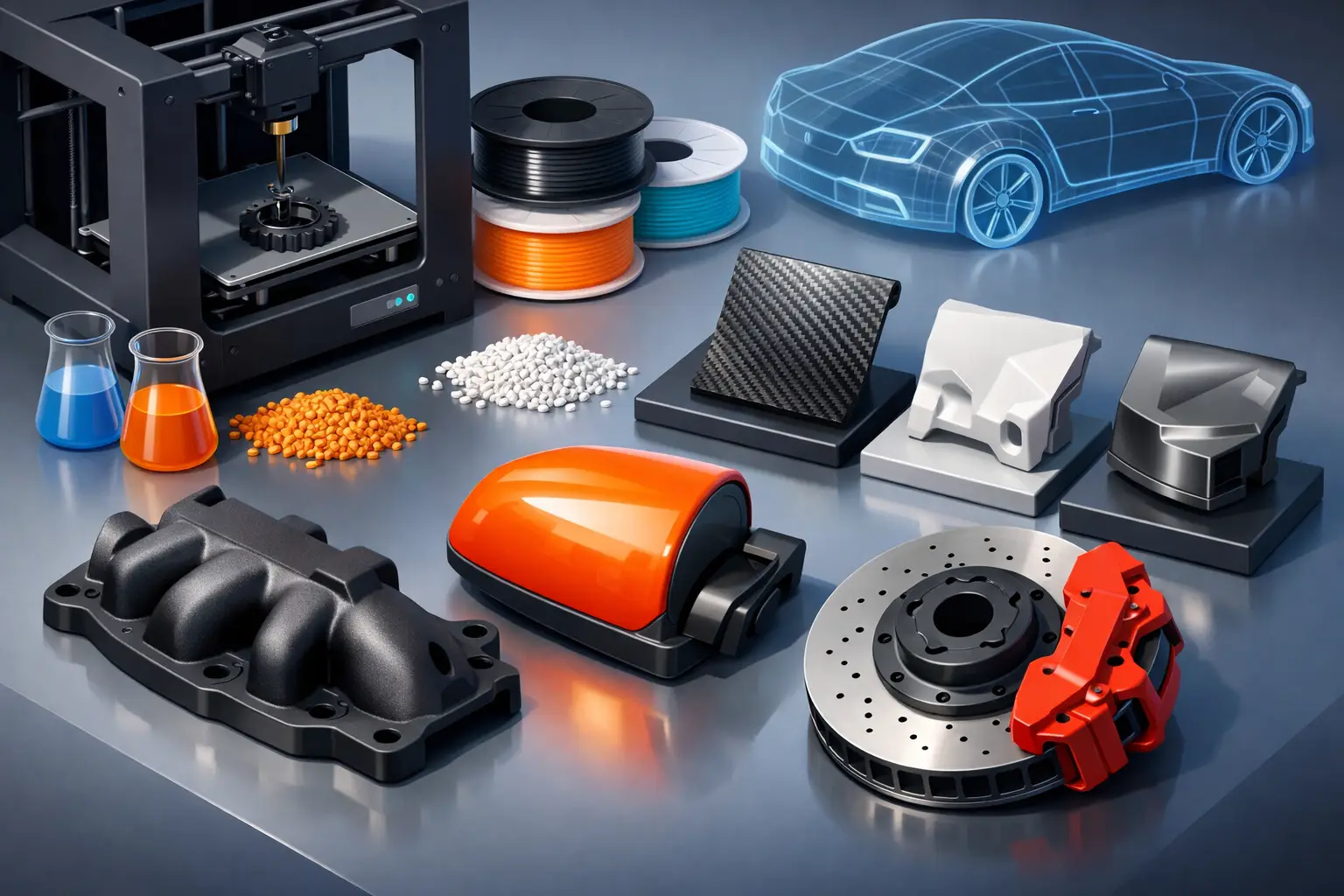
A dashboard clip that sees summer heat needs a different material than a prototype vent, an under-hood cable guide, or a flexible seal. The best 3d printing material for car parts is therefore not one universal filament or resin. It is the material that meets the part's actual operating conditions, fit requirements, expected service life, and production method.
For automotive work, material selection should begin before a file is uploaded for printing. A part may look correct on screen and still fail quickly if it is exposed to heat, fuel vapours, road salt, ultraviolet light, vibration, or repeated load. Defining the application first prevents unnecessary reprints and gives production teams the information needed to select an appropriate technology, orientation, and post-processing option.
Best 3D Printing Material for Car Parts by Application
ASA for exterior trim and UV exposure
ASA is often a practical choice for exterior automotive components that require weather resistance. It handles ultraviolet exposure better than standard ABS and is well suited to items such as grille inserts, mirror-cover prototypes, trim clips, antenna mounts, housings, and non-structural exterior brackets.
Its main advantage is its ability to retain appearance and mechanical performance after outdoor exposure. ASA also provides reasonable heat resistance for many exterior applications. However, it is not the first choice for components positioned close to an engine, exhaust system, or other high-temperature source. Part geometry also matters: thin sections and long unsupported spans can warp during printing if process controls are not correct.
For exterior parts where colour consistency matters, confirm the available material colour and finishing requirements at the order stage. A printed component may still require sanding, coating, or paint to match an existing vehicle finish.
ABS for functional prototypes and interior components
ABS remains a familiar engineering plastic for automotive prototyping because it offers decent impact resistance, workable heat performance, and straightforward post-processing. It is suitable for interior panels, mounts, enclosures, brackets, switch surrounds, and fit-check prototypes where the component will not face prolonged sunlight or demanding chemical exposure.
ABS is useful when a project needs a balance between cost and function. It can be machined, bonded, and finished after printing, which supports prototype iteration. Its limitation is weathering. Without protection, ABS can degrade under UV exposure, making it less suitable for durable exterior use than ASA.
Nylon for tough clips, brackets, and moving parts
Nylon, commonly specified as PA12 or PA6 depending on the process, is a strong candidate for parts that need toughness and fatigue resistance. It is frequently considered for clips, cable retainers, mounts, ducts, gears, bushings, and brackets that see repeated movement or impact.
Compared with ABS or ASA, nylon generally offers better resistance to repeated loading. This makes it valuable when a part must flex slightly without cracking. It also performs well in many industrial environments, though the exact grade should be checked for chemical and temperature exposure.
The trade-off is moisture absorption. Nylon can take on moisture from the environment, changing its dimensions and mechanical behaviour. For a close-tolerance vehicle component, design allowances and controlled material handling are essential. If the part has mating surfaces, threaded inserts, or a critical snap fit, state those requirements before production.
Carbon fibre-filled nylon for stiff functional parts
Carbon fibre-filled nylon increases stiffness and reduces the flexibility associated with unfilled nylon. It is a strong option for rigid brackets, mounts, jigs, fixtures, structural prototype parts, and components where dimensional stability is more important than surface gloss.
This material can produce high-performing parts, but it is not automatically better for every automotive application. The fibres make the material more abrasive, influence the surface finish, and can reduce impact performance compared with an unfilled nylon grade. It may also be less appropriate for parts designed to flex repeatedly, such as snap clips.
Use carbon fibre-filled nylon when rigidity is the priority and the part design accounts for layer direction. A stiff bracket can still fail if the primary load pulls across weak layer interfaces rather than along continuous printed paths.
Polycarbonate for heat and impact resistance
Polycarbonate is used where elevated temperature resistance and impact strength are both required. It can suit protective housings, under-hood prototype components, lighting-related fixtures, and parts exposed to higher thermal loads than ABS or ASA can comfortably handle.
The material requires controlled processing and a capable print setup. It can be more difficult to print accurately than lower-temperature plastics, especially with large or thin-walled parts. It is also not a substitute for validating chemical compatibility. A component exposed to oils, cleaners, fuels, or brake fluid should be assessed against the specific substances it will encounter.
For demanding applications, the question is not simply whether polycarbonate can survive the heat. Confirm how long the part will be exposed, whether it carries load while hot, and whether nearby components restrict expansion.
TPU for flexible automotive parts
TPU is the appropriate category when the part must bend, compress, grip, or absorb vibration. Typical uses include grommets, protective boots, vibration-isolation pads, flexible ducts, cable protection, seals, and soft-touch prototype elements.
Hardness matters. A softer TPU may provide better compression and grip, while a firmer grade may be preferable for a shape-retaining boot or bumper. Flexible materials are also more sensitive to geometry than rigid plastics. Wall thickness, infill, and print orientation can change the final feel of a part significantly.
TPU should not be selected simply because a part feels rubber-like. If the component seals against fluid or must withstand continuous heat, the material grade and application conditions need specific review.
Materials That Need Careful Use
PETG is useful for low-cost prototypes, workshop fixtures, and light-duty interior applications. It has better general durability than PLA and is easier to print than several engineering materials. Yet its heat resistance is limited for many vehicle environments, particularly a closed cabin in direct summer sun or any area near the engine bay.
PLA can be suitable for visual models, early fit checks, or educational projects. It is usually a poor choice for finished car parts because heat can soften it and its long-term impact performance is limited. A PLA part that performs well on a workbench may distort once installed.
Standard photopolymer resin can produce excellent detail for cosmetic models, small interior concepts, and design validation. Most general resins are too brittle for functional automotive parts. Engineering resins may improve heat or impact properties, but they still require application-specific review and may have different ageing behaviour than thermoplastic materials.
Match Material to the Vehicle Environment
Material data sheets are useful, but they do not replace an application brief. Start by identifying where the part will be installed. Interior cabin, exterior bodywork, wheel well, engine bay, and luggage compartment all create different requirements.
For every functional part, document the expected temperature range, UV exposure, contact with chemicals, vibration level, load direction, and required lifespan. In Canada, outdoor parts may also face wide seasonal temperature swings, moisture, road salt, and freeze-thaw cycles. These conditions can turn a suitable prototype material into an unsuitable service material.
Then consider the consequence of failure. A cosmetic trim insert and a component that supports wiring are not evaluated the same way. Parts associated with braking, steering, suspension, airbags, occupant restraint, fuel delivery, or other safety-critical systems should not be replaced with unvalidated 3D-printed components. These applications require engineering assessment, appropriate testing, and compliance with relevant vehicle requirements.
Printing Process and Part Design Affect Performance
The material name is only part of the specification. Fused filament fabrication parts are anisotropic, meaning they are generally weaker between printed layers than within a layer. A bracket printed in the wrong orientation can split under load even when the selected polymer is otherwise appropriate.
Wall thickness, infill strategy, perimeter count, radiused corners, and fastener design also affect performance. For load-bearing features, avoid sharp internal corners and avoid relying on printed threads where repeated assembly is expected. Heat-set inserts, captive hardware, or designed mechanical interfaces may provide a more reliable result.
For tight-tolerance parts, allow for the selected technology's dimensional capability and any finishing process. A press fit, snap fit, or mating duct may need iteration, particularly when replacing a part from an older vehicle with worn or variable dimensions.
Specify the Order Clearly
A controlled order process reduces avoidable delays. Include the part's intended use, material preference, required colour, quantity, critical dimensions, post-processing needs, and any known heat or chemical exposure. If the part is a revision, identify what changed from the previous version and why.
Print3Dcanada customers can use material selection and order-management controls to keep these production inputs tied to the job record. This is particularly useful for teams managing repeat parts, prototype revisions, or multiple vehicle projects with different material requirements.
The right material choice starts with a clear description of the part's job. When the operating environment, load case, fit requirements, and finish are specified together, the printed component can be selected and produced as a controlled manufacturing item rather than a trial-and-error replacement.