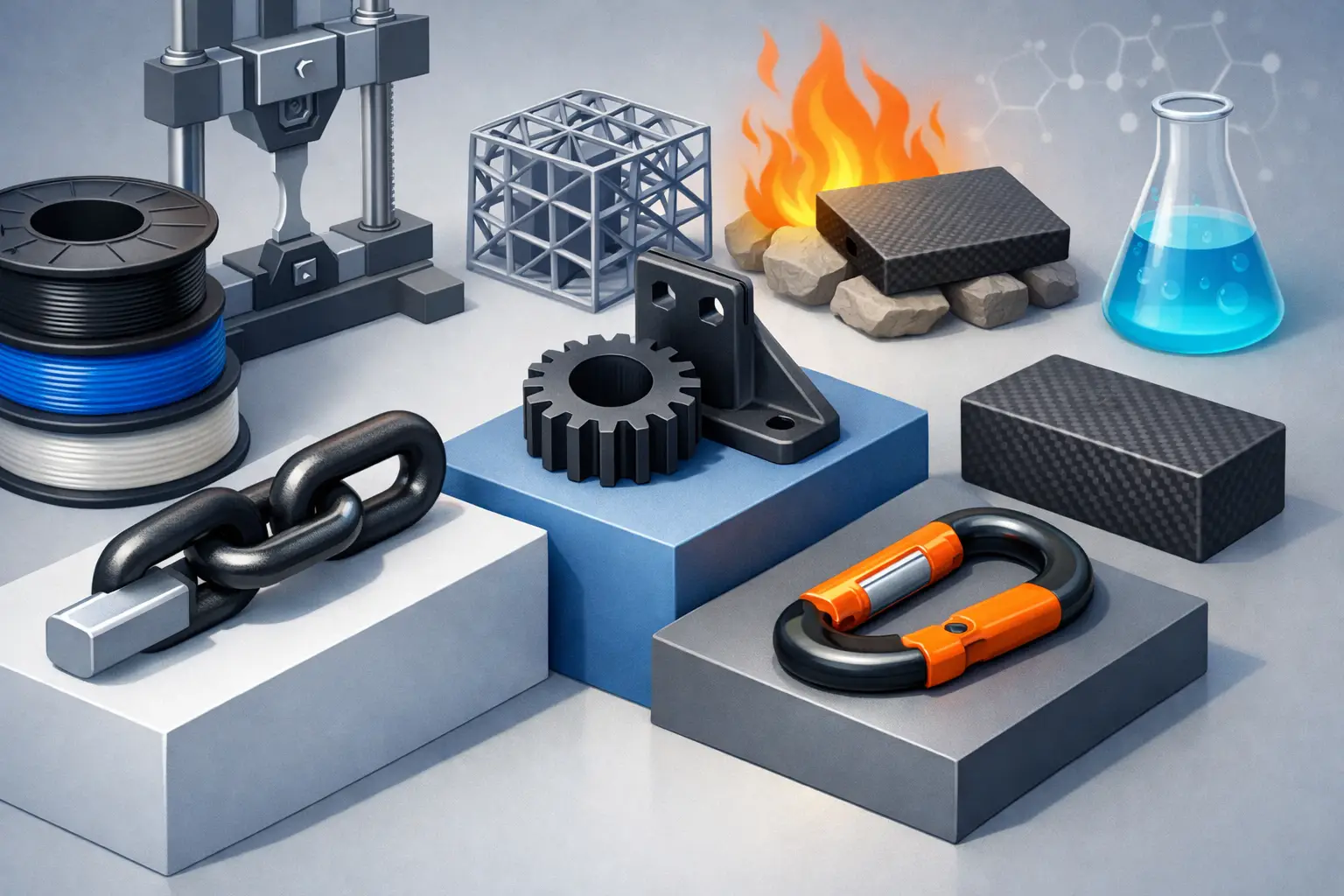
A part can have a high tensile-strength rating and still fail quickly in service. It may crack under impact, soften near a heat source, creep under a sustained load, or split along layer lines. That is why the best 3d printing material for strength is not one universal material. The correct choice depends on how the component is loaded, its operating environment, its geometry, and the printing process used to make it.
For functional prototypes, fixtures, brackets, enclosures, and low-volume production parts, material selection should begin with the failure you need to prevent. A part that needs to resist bending calls for a different material balance than a snap-fit, a press-fit, or a part mounted beside a motor.
Define what strength means for the part
“Strong” is often used as a catch-all term, but material data separates several properties that matter in different ways. Tensile strength measures resistance to being pulled apart. Stiffness, usually shown as tensile modulus, indicates how much a part deflects under load. Impact resistance indicates how well it handles shocks, drops, and sudden loading. Heat resistance matters when a part must retain its shape and load capacity at elevated temperatures.
Creep is another frequent concern. A material can hold a load briefly but gradually deform when that load remains in place for days or months. This matters for clamps, threaded interfaces, mounted brackets, and parts that support equipment continuously.
Layer adhesion must also be considered for extrusion-based printing. A material's published bulk properties do not automatically describe every printed orientation. When a load pulls across layer boundaries, the printed part may be weaker than the same design loaded within the layer plane. For critical components, orient the main load through continuous perimeters and layers where possible, not across them.
Best 3D printing materials for strength by application
Nylon: strong, tough, and practical for functional parts
Nylon, commonly supplied as PA11 or PA12 in powder-bed processes and as various filament grades for extrusion, is often a strong starting point for working components. It combines good tensile performance with toughness and fatigue resistance. Unlike very rigid plastics, nylon can flex before failing, making it useful for clips, housings, gears, brackets, and parts subject to repeated handling.
PA12 is especially common for durable production parts because it has relatively low moisture absorption compared with some other nylons and provides dependable dimensional performance. PA11 generally offers greater ductility and impact resistance. The trade-off is that nylon may not be the best choice where maximum stiffness is required, and moisture management remains relevant for both material storage and end use.
Carbon-fibre-filled nylon: high stiffness with design limits
Carbon-fibre-filled nylon is a leading option when the requirement is stiffness, dimensional stability, and improved resistance to bending. The fibres reinforce the polymer, so a well-designed part can feel substantially more rigid than unfilled nylon. It is commonly specified for jigs, fixtures, structural brackets, tooling aids, and lightweight machine components.
The limitation is brittleness relative to unfilled nylon. Carbon-fibre reinforcement can reduce impact performance and elongation at break. Sharp internal corners, thin snap features, and sudden impacts are less forgiving. Fibre-filled materials can also be abrasive during extrusion and may require a suitable nozzle and controlled processing. Choose it when deflection is the problem, not simply because the material has a higher strength figure.
Polycarbonate: strong under load and heat
Polycarbonate is a useful candidate for parts that need high strength, stiffness, and better heat performance than common general-purpose filaments. It can suit machine guards, electrical enclosures, demanding brackets, and components exposed to moderate elevated temperatures.
Its processing window is less forgiving than PETG or standard ABS. Warping, residual stress, and inconsistent layer bonding can reduce final-part performance if temperature control is inadequate. Polycarbonate is therefore most effective when the selected print technology and production setup are designed for it. A properly produced polycarbonate part can perform very well; a poorly controlled one may not meet the design intent.
PETG: reliable for moderate functional loads
PETG sits between basic prototype plastics and engineering-grade materials. It offers good layer bonding, useful impact resistance, and easier processing than polycarbonate or many nylons. For lightly to moderately loaded mounts, guards, containers, and prototypes, it can be a cost-effective choice.
It is not normally the best material for high-temperature service, long-term static loading, or highly rigid structural parts. PETG can deform gradually under sustained stress, particularly in warm environments. It is a practical material when the duty cycle is reasonable and the design has adequate section thickness.
ABS and ASA: useful where heat and outdoor exposure matter
ABS remains relevant for functional enclosures and components that need more heat resistance than PLA. ASA has similar mechanical behaviour with better resistance to ultraviolet exposure, making it suitable for outdoor housings and external fixtures.
Neither material automatically outperforms nylon, polycarbonate, or fibre-filled composites for every strength requirement. Their value is in the balance of cost, heat tolerance, machinability, and, for ASA, weather resistance. Warping and shrinkage must be allowed for in both material selection and part design.
High-performance polymers: for demanding environments
PEEK, PEKK, and related high-performance polymers are used where heat, chemical exposure, flame requirements, or high mechanical loads exceed the capability of standard engineering plastics. These materials can be appropriate for specialized industrial, aerospace, medical, and energy applications.
They also require capable equipment, controlled processing, and a budget aligned with the application. Specifying a high-performance polymer for a simple room-temperature bracket can add cost without adding meaningful value. The service environment must justify it.
Do not select by tensile strength alone
A tensile-strength chart is useful for narrowing options, but it should not be the final decision tool. Consider the complete operating condition: peak load, direction of load, repeated cycles, temperature, moisture, chemicals, vibration, and the consequence of failure.
For example, a rigid carbon-fibre nylon bracket may be preferable where alignment cannot change under load. An unfilled nylon component may be better where the part will be bumped or flexed repeatedly. Polycarbonate may be the better fit near heat, while ASA may be more appropriate for an outdoor enclosure. The material with the largest number on a data sheet is not always the part that lasts longest.
Printing technology changes the result
The same polymer can produce different outcomes depending on the process. In fused filament fabrication, layer orientation, nozzle temperature, chamber conditions, wall count, infill pattern, and infill percentage all affect strength. For a load-bearing part, adding perimeters and increasing material around holes or fasteners often contributes more than moving from 50% to 100% infill.
Powder-bed methods such as selective laser sintering and multi jet fusion can produce nylon parts with more consistent behaviour across complex shapes and without the support structures associated with many extrusion builds. They are often well suited to functional assemblies, batch production, and geometries with internal channels or multiple features.
Post-processing can matter as well. Annealing may improve stability for certain materials. Vapour smoothing, dyeing, machining, inserts, and protective finishes can change the final function or fit. These requirements should be defined with the order, rather than treated as an afterthought.
Design choices that add more strength
Material selection works best alongside practical design changes. Increase wall thickness where bending occurs, add fillets at inside corners, and use ribs to reduce deflection without adding unnecessary mass. Avoid placing fasteners too close to an edge, and use heat-set or threaded inserts when threads will be assembled repeatedly.
Holes, slots, and abrupt section changes concentrate stress. A small fillet or a wider transition can have more effect on real-world durability than a minor upgrade in material grade. If a part will carry a known load, document that load, the mounting condition, and the allowable deflection before requesting production.
For repeat orders or team purchasing, record the selected material, colour, technology, orientation requirement, post-processing, and revision level in the job specification. A controlled order record helps ensure the replacement part matches the validated one. Print3Dcanada's configuration and order-tracking workflow is intended to keep those production inputs tied to the job.
Set the material decision before checkout
Start with the part's failure mode, then narrow the selection by stiffness, impact resistance, heat, environment, and process capability. If the application is safety-critical, load-bearing around people, or expensive to replace, validate the design with a prototype and an appropriate test before committing to a production run. A clear requirement at the ordering stage is the most reliable way to receive a part that is strong for the job it actually has to do.