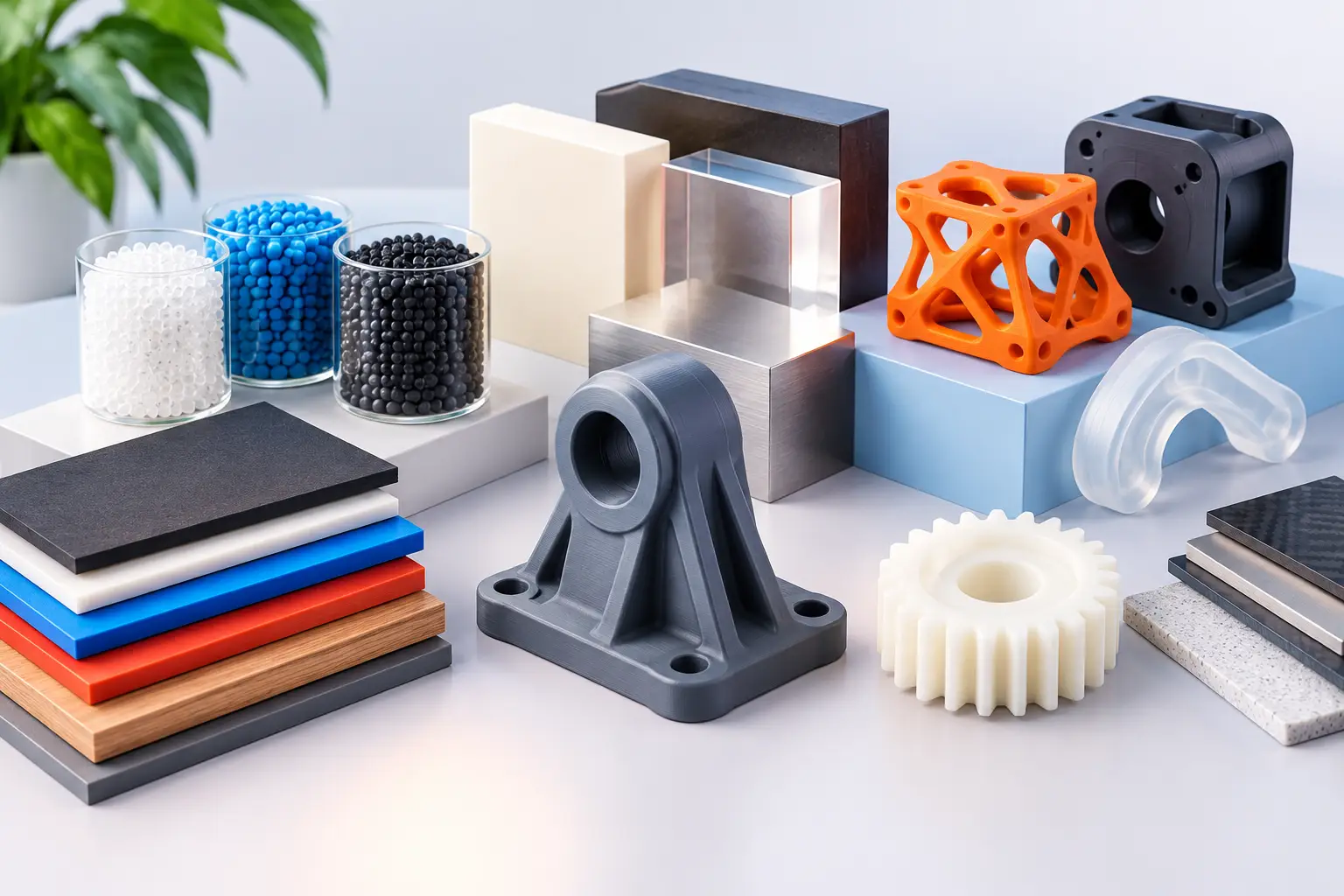
A prototype that looks correct but cracks at a mounting point, warps near a motor, or binds against its mating part has not answered the question it was built to test. The best materials for functional prototypes are selected around the job the part must perform, not simply the lowest print cost or the smoothest surface.
For functional work, material selection should begin with the failure mode you are trying to avoid. A hand-held enclosure may need impact resistance and good cosmetic finish. A fixture may need stiffness and dimensional repeatability. A clip, hinge, or living feature needs flexibility and fatigue resistance. These are different requirements, and they point to different materials and printing processes.
Start with the prototype's operating conditions
Before uploading a part for production, define how it will be used. Record the expected load, direction of force, temperature exposure, contact with chemicals or moisture, required tolerances, and number of test cycles. If the component interfaces with another part, identify which dimensions control the fit.
This step prevents a common prototype mistake: specifying a general-purpose material for a highly specific test. A thin wall that works in a visual model may fail under a screw load. A dimensionally accurate print may still be unsuitable if it softens at the temperature created by nearby electronics.
Also consider whether the prototype represents a single validation step or a bridge to production. Early form studies can favour speed and cost. Later engineering samples should use a material with mechanical behaviour that is closer to the intended final part, even if the print requires more planning or post-processing.
Best materials for functional prototypes by requirement
No single material is best across every use case. The practical choice is the one that gives the test credible results while fitting the required production timeline and budget.
PLA for quick fit and low-load validation
PLA is often suitable for early prototypes where geometry, assembly sequence, and basic fit are the primary concerns. It prints with good detail and dimensional consistency, making it useful for enclosure checks, display parts, jigs with limited loading, and concept models that need to be evaluated quickly.
Its limitations matter in functional testing. PLA can be brittle under impact and has limited heat resistance compared with engineering plastics. It is usually not the right choice for clips, stressed fastener locations, outdoor parts, or components exposed to elevated temperatures. Use it when the question is, “Does this shape fit?” rather than, “Will this survive service conditions?”
PETG for durable general-purpose parts
PETG is a practical step up when a prototype needs more toughness than PLA and may encounter moderate moisture, handling, or repeated use. It is frequently appropriate for protective covers, brackets, containers, guards, and general-purpose fixtures.
The material offers a useful balance of strength, impact resistance, and printability. It can be less rigid than PLA, however, so a part designed around stiffness may need thicker walls or reinforcing ribs. PETG may also show more surface stringing depending on geometry and process settings, which can affect cosmetic requirements or close-tolerance interfaces.
ABS and ASA for heat and environmental exposure
ABS remains relevant when a functional prototype requires improved heat resistance and impact performance. It is commonly considered for automotive-adjacent applications, equipment housings, and parts that will experience warmer operating conditions than PLA or PETG can reasonably support.
ASA provides similar functional characteristics with better resistance to UV exposure and weathering. For an outdoor enclosure, a field-mounted bracket, or a part exposed to sunlight, ASA is often the more suitable option.
Both materials require controlled printing conditions to manage shrinkage and warping. That process requirement is part of the material decision. If a prototype contains large flat surfaces, long thin walls, or tightly controlled assembly dimensions, review the geometry and tolerances before committing to ABS or ASA.
Nylon for toughness, wear, and working mechanisms
Nylon is a strong option for prototypes that need toughness, abrasion resistance, and some flexibility. It is used for functional brackets, gears, clips, moving interfaces, and components expected to absorb impact without immediate fracture.
Its trade-off is moisture absorption. Nylon can change properties and dimensions as it takes on moisture from its environment, which may affect precision fits. It is also less naturally rigid than materials such as PLA or reinforced composites. For moving or load-bearing parts, those characteristics can be advantages. For a tightly toleranced housing, they require deliberate design allowances.
TPU for flexible and impact-absorbing components
TPU is selected when the prototype must bend, compress, grip, or absorb shock. Typical applications include protective boots, gaskets, feet, cable guides, flexible latches, wearable components, and soft-touch overmould concepts.
Flexibility is not a single property. TPU grades vary in hardness, and geometry changes the result substantially. A thin TPU wall can flex freely, while a thick section of the same material can feel quite firm. When testing a seal or snap feature, model the expected compression range and ensure the printed orientation supports the direction of use.
Reinforced polymers for high-stiffness prototypes
Carbon-fibre-filled or glass-fibre-filled polymers are useful when stiffness, strength-to-weight ratio, and reduced flex are the priority. They can suit structural brackets, manufacturing aids, drone or robotics components, and fixtures that must hold their shape under load.
Reinforcement does not automatically make a part better. Filled materials can be more abrasive to process, may have a different surface finish, and can be less forgiving in thin, highly flexible features. They are generally chosen for rigid functional parts, not living hinges or parts designed to bend repeatedly.
Resin materials for detail and specialized performance
Resin-based printing can produce fine features, smooth surfaces, and precise small parts. Standard resins are useful for fit checks, appearance models, and intricate geometries, but they are not always suitable for sustained mechanical loading.
Engineering resin families expand the options. Tough resins can support impact-oriented applications, while high-temperature resins can support heat-related tests. Flexible resins serve soft components and seal concepts. The specification should be reviewed closely because resin properties vary significantly by formulation, post-curing method, and part orientation.
Material is only one part of functional performance
A functional prototype's result is also shaped by wall thickness, infill strategy, print orientation, layer height, support placement, and post-processing. A strong material printed with layers aligned poorly to the load can split along layer lines. Conversely, a properly oriented part with local ribs and generous fillets can perform well without moving to a more expensive material.
For load-bearing features, avoid placing high stress at sharp internal corners. Add fillets where possible, increase material around fasteners, and use heat-set inserts or through-bolts instead of repeatedly threading directly into plastic when the assembly will be opened many times.
Tolerance planning deserves the same attention. Printed holes often require clearance, mating surfaces may need adjustment, and post-processing can alter dimensions. For assemblies, state which features are critical and whether the print is intended for press fit, sliding fit, threaded hardware, or visual alignment only.
Choose the process alongside the material
Fused filament fabrication is often efficient for larger parts, fixtures, enclosures, and iterative mechanical tests. It provides a broad material range and can be a cost-effective choice when visible layer texture is acceptable.
Resin printing can be better for intricate forms, fine surface detail, small precision components, and specialized material requirements. Selective laser sintering and similar powder-based processes can suit durable nylon parts, complex geometries, and batches where support-free design freedom is valuable. The right process depends on the functional target, geometry, finish requirement, and quantity.
When placing an order, provide the use case with the file where possible. A note such as “bracket tested under repeated bending,” “enclosure near a warm power supply,” or “snap fit requires 20 assembly cycles” gives the production team context that a material name alone cannot provide.
For teams managing multiple iterations, keep the material, colour, process, revision number, and test result attached to each order record. Print3Dcanada's structured order workflow can help maintain that traceability as a prototype moves from concept fit to functional validation.
The most useful prototype is not necessarily the one that resembles the final product most closely. It is the one that produces a reliable answer to the next engineering question, with a material and process selected to make that answer credible.