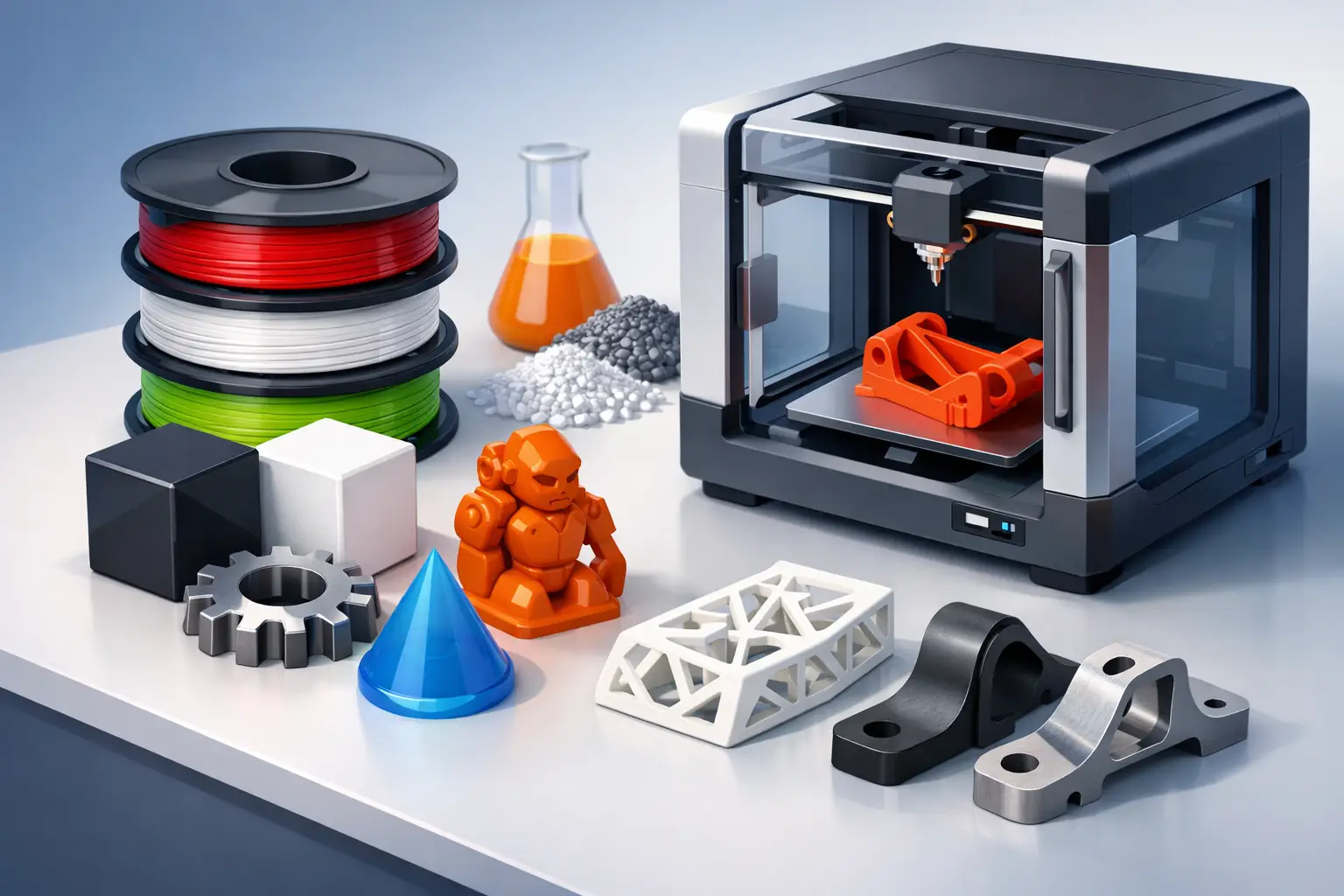
A material choice can determine whether a printed enclosure clips together cleanly, a fixture survives repeated use, or a prototype fails before testing begins. 3d printing materials are not interchangeable inputs. Each option brings different mechanical behaviour, surface quality, dimensional tolerance, environmental resistance and post-processing requirements to the part.
For a custom order, the right decision starts with the part's job rather than its appearance. A rigid display model, a living hinge, a heated under-hood bracket and a patient-specific educational model may all look suitable for 3D printing, but they require very different material properties. Defining those requirements before submission reduces revisions, cost changes and production delays.
How to select 3D printing materials
Start with the conditions the finished part must handle. Consider the load it carries, how often it will be handled, its operating temperature, exposure to moisture or chemicals, and whether appearance is functional or presentation-critical. Also identify whether the part is a one-off prototype, a production aid or an end-use component.
Strength alone is not enough. A stiff material can resist bending but crack under impact. A tougher material may flex without breaking but be less dimensionally stable. Some materials provide good heat resistance but need a printing process designed to control warping. The material specification should reflect the failure mode that matters most for the application.
Match the material to the part function
PLA is often suitable for visual models, concept prototypes and low-stress parts. It generally prints with good detail and a clean surface, but its heat resistance and long-term performance under load are limited. It is usually not the first choice for components exposed to warm vehicles, machinery or outdoor summer conditions.
PETG offers a useful balance for many practical prototypes and light-duty functional parts. It typically provides better impact and moisture resistance than PLA, with a degree of flexibility that can be useful for clips, covers and protective housings. The trade-off can be a less refined surface finish and more careful tolerance planning around small features.
ABS and ASA are commonly considered when heat resistance and durability are more important. ASA is particularly relevant for parts that will spend time outdoors because it is designed for improved weatherability and UV exposure compared with standard ABS. Both require process control, as shrinkage and warping can affect larger flat parts and tight dimensions.
Nylon is valued for toughness, fatigue resistance and wear performance. It can be appropriate for gears, snap-fit features, brackets and components that experience repeated motion. However, nylon can absorb moisture, which affects both printing and finished-part behaviour. A nylon component should be specified with its operating environment in mind, not selected solely because it is strong.
TPU and other flexible materials are used where compression, grip, vibration damping or repeated flexing is needed. These materials suit gaskets, protective boots, soft-touch components and strain-relief features. Flexible parts need a different design approach: wall thickness, internal geometry and material hardness can significantly change the final feel and performance.
For higher-performance applications, engineering polymers and resin-based materials may be considered for heat, stiffness, fine detail, chemical resistance or specialized mechanical properties. Their suitability depends on the printing technology, orientation, curing process and post-processing. A material name by itself does not guarantee a specific result.
Material choice depends on printing technology
The same broad material family can perform differently across additive manufacturing processes. Filament-based printing is often a practical option for prototypes, fixtures and larger parts where cost and speed matter. Layer lines may be visible, and the part's strength can vary by print orientation because layers bond in a particular direction.
Resin printing is often selected for fine detail, smooth surfaces and intricate geometries. It can be effective for presentation models, dental or medical workflows where applicable, casting patterns and parts with small features. Standard resins can be relatively brittle, so functional resin options should be chosen based on the required impact, temperature and stiffness characteristics.
Powder-based processes can support complex, durable components without many of the support structures associated with other methods. They may be suitable for functional polymer or metal parts, particularly when geometry, repeatability and production quantity justify the process. Surface texture, finishing requirements and cost structure should be reviewed early.
This is why material selection and technology selection should happen together. A design that performs well in one process may need different wall thicknesses, clearances or fastening features in another. Provide the intended material whenever possible, but allow the production review to identify a better process-material combination if the file and application indicate one.
Design details that affect material performance
Part geometry can either support or undermine the material selected. Sharp internal corners concentrate stress, while fillets spread it. Very thin walls may look acceptable in a model but deform, crack or fail during finishing and use. Long unsupported spans can sag, and large flat surfaces can distort depending on the process and material.
For assemblies, clearances require particular attention. A press fit, sliding lid or threaded feature designed for injection moulding may not behave the same way when printed. Build orientation, material shrinkage and surface texture all affect the final fit. State which dimensions are critical and whether the part mates with another component. This gives the production team a clear basis for reviewing tolerances.
Fasteners also deserve a deliberate choice. Self-tapping screws can work in some printed polymers, while threaded inserts may provide more reliable repeated assembly. Snap fits need materials with appropriate flexibility and fatigue resistance. When a feature will be opened, tightened or flexed repeatedly, test it in the intended material rather than relying on a visual prototype.
Colour and finish are part of the specification as well. A colour choice may affect availability, lead time or the suitability of a material for a given process. Post-processing such as support removal, sanding, coating, machining or assembly can improve appearance and usability, but it adds handling steps and may alter dimensions. Specify whether a cosmetic surface, a functional surface or a particular contact face is the priority.
Use a clear specification before placing the order
A useful order record does more than attach an STL file. It identifies the material, colour, technology where known, quantity, intended use and required finish. Include critical dimensions, assembly notes and any performance requirements such as temperature exposure, impact resistance or electrical insulation. If the part is replacing an existing component, explain what failed in the previous version.
For teams, this information should remain connected to the job throughout quoting, production and fulfilment. Centralized order management is especially useful when several people need visibility into the same project, when prototype revisions are being compared, or when purchasing requires invoices and traceable status updates. It also prevents a common problem: a technically sound design being produced in the wrong colour, material or revision.
Before approving an order, check the following operational points:
- Is the selected material suited to the actual load, temperature and environment?
- Are critical dimensions, mating parts and fit requirements identified?
- Does the requested finish match the part's functional or visual purpose?
- Is the quantity appropriate for a first article, pilot run or repeat production need?
- Are delivery timing, shipping requirements and any certification needs recorded?
Prototype with intent, then standardize
The first printed part is often a decision tool, not the final answer. A lower-cost prototype can confirm geometry, ergonomics and assembly sequence before an engineering-grade material is used for functional testing. That approach is efficient when the basic shape is still changing. It is less useful when the main risk is heat, impact or fatigue performance, since those tests need a material close to the final specification.
Once a part has passed testing, keep its approved settings together: file revision, material, colour, technology, orientation where relevant, finish and quantity. This creates a repeatable production baseline. Future orders can then focus on changes that matter, rather than reopening basic material decisions every time a replacement part or small batch is needed.
The most reliable material choice is the one documented against a specific use case. Define what the part must withstand, identify the features that control fit and function, and submit those requirements with the order. That gives the production workflow enough information to turn a digital file into a part that is ready for its intended job.