A custom part rarely fails because someone could not print it. It fails because a critical production detail was unclear: the material was unsuitable, the revision was wrong, the finish was not specified, or nobody could confirm where the order stood. Digital manufacturing addresses that operational gap by connecting design data, production choices, order controls and fulfilment status in one managed workflow.
For product teams, engineers and buyers, the value is not limited to faster prototyping. A structured digital process makes custom production easier to specify, review, repeat and document. That matters when a one-off fixture becomes a recurring order, when several people need access to the same job information, or when a purchasing record must match what was actually produced.
What digital manufacturing means in practice
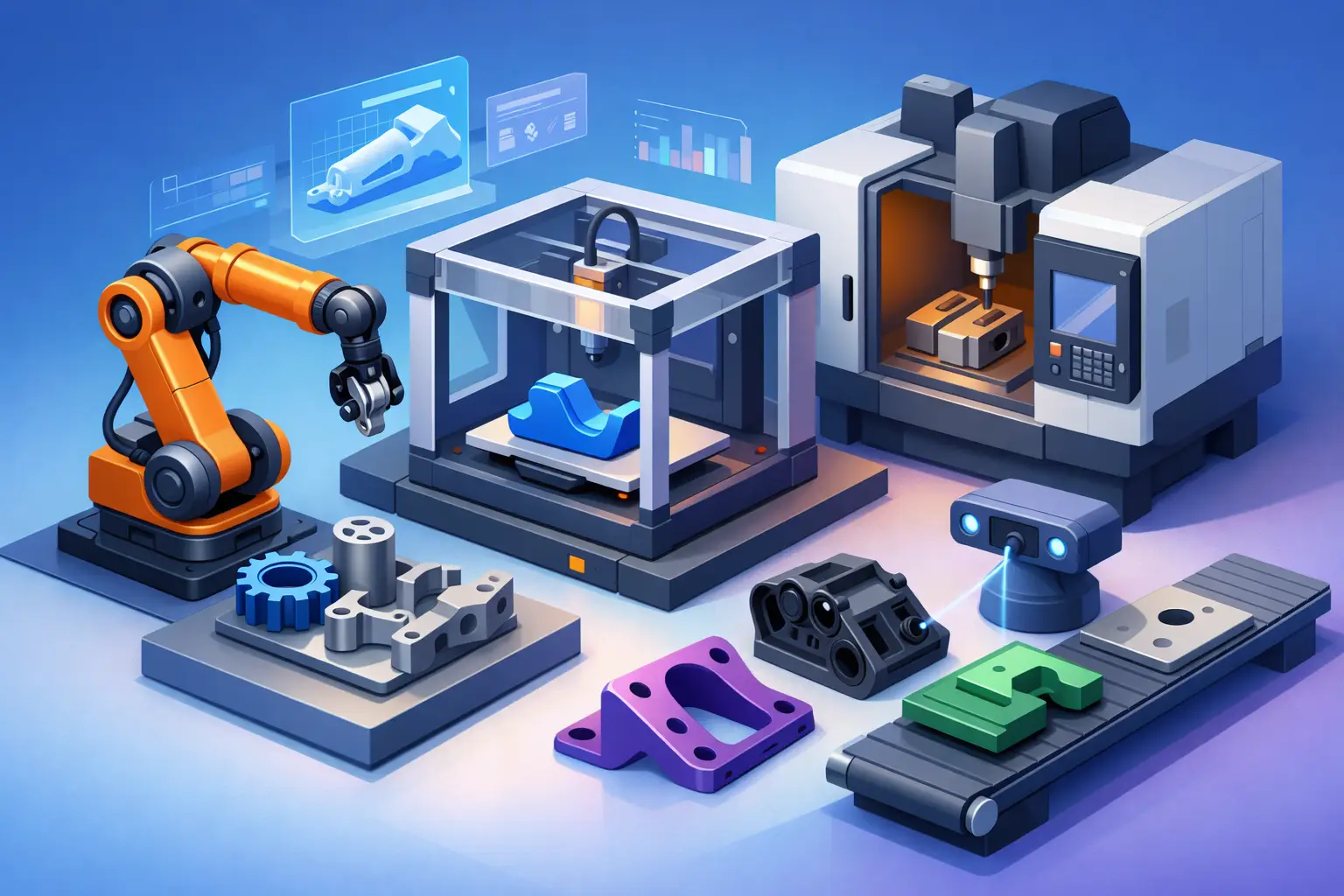
Digital manufacturing is the use of connected software, production data and digitally controlled equipment to plan, make and manage physical parts. In additive manufacturing, the workflow typically begins with a 3D model and continues through material selection, machine preparation, printing, post-processing, quality checks and shipping.
The key distinction is control of information. A 3D printer can produce a part from a file, but a manufacturing workflow also needs to capture the choices around that file. Which material is approved? Is a specific colour required? Does the part need support removal, smoothing or another finishing step? Is certification needed? What quantity, charge, delivery method and invoice apply to the order?
When these details are held in emails, informal notes and separate spreadsheets, errors become more likely as order volume grows. A digital system ties them to the production record. The result is a clearer handoff between the person requesting a part, the team preparing it and the customer receiving it.
Why it matters for custom 3D-printed parts
Custom manufacturing has more variables than catalogue purchasing. Two parts with the same outside dimensions may require very different production approaches because of load, heat exposure, surface requirements, tolerances, colour, geometry or intended service life.
Digital manufacturing creates a practical place to make those decisions before production begins. This is particularly useful for additive manufacturing, where orientation, wall thickness, support requirements and material behaviour can affect strength, appearance, cost and lead time. The lowest quoted price is not always the best production choice if it leads to extra finishing, reduced durability or a part that does not suit its intended use.
For a prototype, speed may be the main priority. For a production aid, a functional polymer with predictable mechanical performance may matter more. For a customer-facing model, colour and surface finish may take priority. The right choice depends on the application, and the order workflow should make those trade-offs visible rather than treating every uploaded file as the same type of job.
The production record becomes the reference point
A reliable order record gives teams a shared version of the job. It should identify the selected material, colour options, technology, quantity, post-processing requirements, pricing and fulfilment information. If a part is reordered, those specifications provide a starting point instead of forcing the team to reconstruct an earlier decision.
This is useful for individual makers, but it becomes essential for collaborative work. Designers can define requirements, technical staff can review manufacturability, and purchasing stakeholders can manage charges and invoices without losing sight of the same production status. Account access and defined order information reduce the ambiguity that often appears when several people are involved.
Status tracking supports planning, not just convenience
Order tracking is often treated as a customer-service feature. In a production environment, it is also a planning tool. Knowing whether a job is awaiting review, in production, being post-processed or ready for delivery helps teams coordinate assembly, testing and downstream work.
Clear status information does not eliminate lead-time variation. Material availability, machine capacity, part geometry, finishing requirements and shipping destination can all affect the schedule. It does, however, make those dependencies easier to manage. A team can act on a visible production state rather than chasing updates through separate conversations.
Building an effective digital manufacturing workflow
The strongest workflow is not necessarily the most complex one. It is the one that captures the decisions needed to produce the part correctly while keeping ordering straightforward for the customer. For most custom 3D-printing requirements, that process begins with a production-ready design file and a clear statement of the part's function.
Before submitting an order, confirm the basic questions that influence production: what the part must do, what environment it will operate in, how accurate it needs to be, how many units are required and whether appearance affects acceptance. These requirements guide material and technology selection more effectively than choosing based on colour or price alone.
The next step is configuration. A capable platform should present applicable materials, colours, machines, technologies and post-processing choices in a way that can be attached to the order. This is where standardization helps. Instead of relying on an open-ended message to describe every instruction, the order captures defined production inputs that can be reviewed consistently.
Commercial controls belong in the same workflow. Quotes or charges, shipping details, taxes where applicable, secure payment and invoices should correspond to the specific job. For business customers, this connection is valuable because it gives purchasing and finance teams a traceable record without separating commercial administration from production specifications.
Finally, fulfilment needs the same level of attention as printing. A well-made part still needs correct packaging, shipping or delivery coordination, and a visible completion status. For Canadian customers working across provinces or managing remote teams, centralizing this information reduces friction between design approval and receipt of the final part.
Where digital manufacturing requires judgement
A connected workflow improves control, but it cannot replace engineering judgement. A platform can record a material choice; it cannot determine whether that material is appropriate for a safety-critical load unless the requirement has been properly defined and assessed. It can show a delivery status; it cannot remove transit risk or guarantee that a late design change will have no effect on timing.
There are also cases where a simpler process is appropriate. A low-risk visual model may not need extensive documentation or certification. A repeat order with unchanged specifications can move quickly once the original configuration has been validated. By contrast, a part used for testing, tooling or an operational assembly may justify more review, clearer acceptance criteria and documented finishing requirements.
The practical goal is proportional control. Capture enough information to prevent avoidable errors, but do not turn a simple print into an administrative exercise with no production benefit.
Choosing a production partner with digital control
When evaluating a custom 3D-printing provider, look beyond the list of available machines. The operating process matters just as much. Ask whether the provider can manage material availability, configured options, post-processing, certification needs, order status, delivery and payment records in a consistent system.
For recurring or team-based work, also consider how easily users can access account information, review past jobs and track active orders. A clear platform reduces dependence on individual email threads and gives stakeholders a reliable source for specifications and fulfilment details.
Print3Dcanada applies this type of structured approach to configurable additive-manufacturing orders, giving customers one place to select production options and follow the job through fulfilment. That model is useful when the requirement is not simply to print a file, but to manage a custom part as a controlled production order.
The next time a part is requested, begin with the production decisions that will still matter after the file has been uploaded. Clear material requirements, documented finishing, accountable order status and defined delivery details make the physical result easier to trust and easier to repeat.