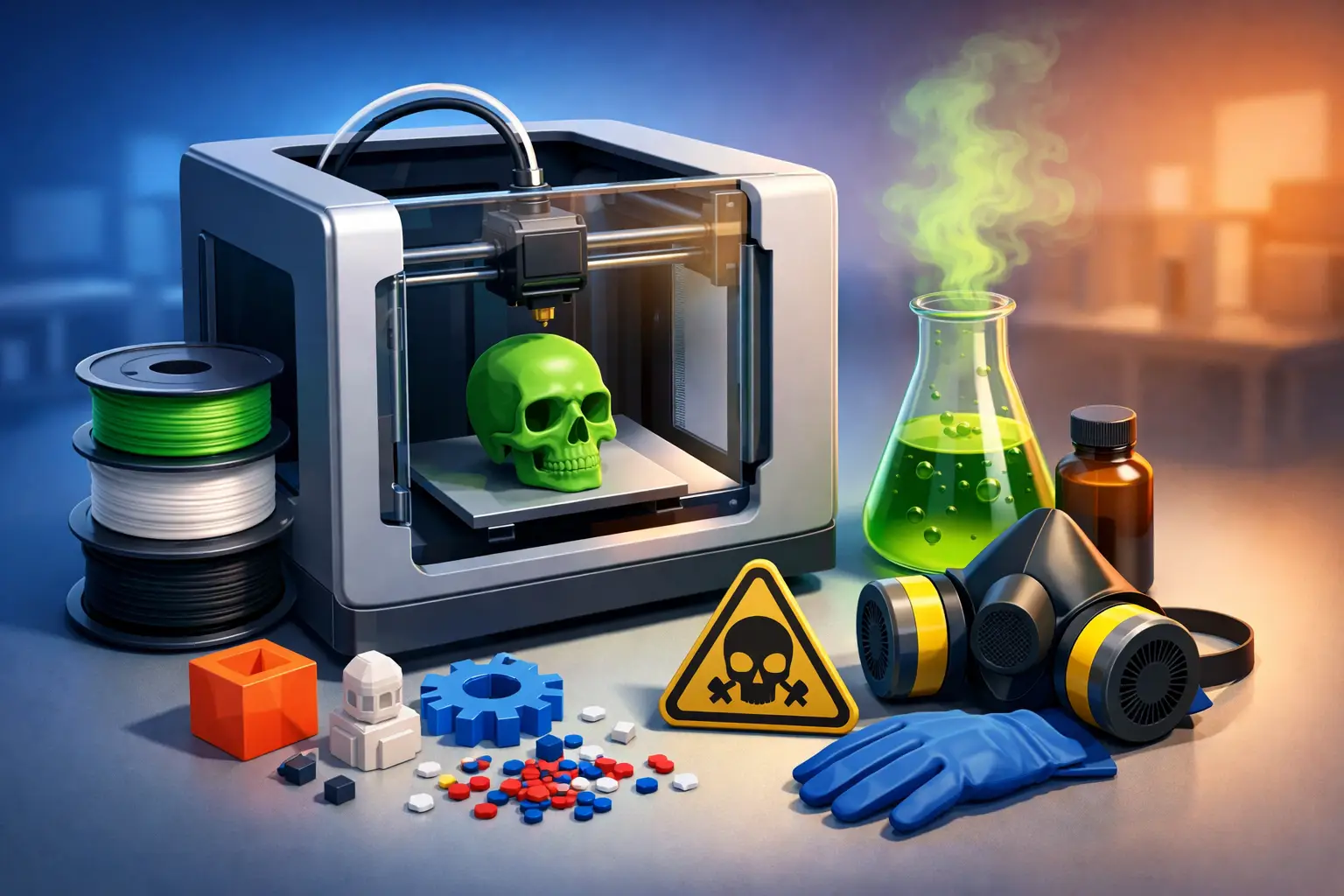
A material can be suitable for a production part and still require controlled handling during printing, cleaning, sanding, or disposal. That is the practical answer to is 3D printing material toxic: toxicity is not a single property of a finished 3D-printed object. It depends on the material chemistry, printing process, exposure route, temperature, post-processing steps, and intended use.
For buyers, the key question is not simply whether a material is “safe.” It is whether the selected material is appropriate for the part’s working environment and whether the people handling it have the right controls in place. A prototype enclosure, a wearable item, a food-contact tool, and a resin-printed dental model each create different requirements.
Is 3D Printing Material Toxic During Printing?
The highest exposure risk usually occurs before and during production, rather than after a part has been fully processed. Heat, uncured chemicals, fine powders, solvents, and finishing dust can all create hazards that need to be managed through material-specific procedures.
Filament printing: emissions matter
Common fused-filament materials such as PLA, PETG, ABS, ASA, nylon, TPU, and polycarbonate are supplied as solid thermoplastic filament. Handling an unopened spool is generally low risk. During printing, however, the nozzle heats the polymer and can release ultrafine particles and volatile organic compounds, often called VOCs.
The quantity and composition of emissions vary by polymer, colourant, additives, nozzle temperature, machine enclosure, and print duration. ABS and ASA generally require more careful ventilation than PLA because they are printed at higher temperatures and can produce more noticeable odours and emissions. Odour is not a reliable measure of risk, though. A material can produce little smell while still releasing particles.
For an office, classroom, workshop, or production area, the appropriate control is not simply opening a window. Use equipment and facilities designed for the process: enclosed printers where applicable, local exhaust or suitable filtration, and a room layout that keeps routine work away from active machines. Avoid placing a desktop printer beside permanent workstations or in poorly ventilated occupied rooms.
Resin printing: uncured resin requires direct controls
Photopolymer resin printing uses liquid resins that cure under light. Uncured resin should be treated as a chemical exposure risk. It can irritate skin and eyes, and repeated skin contact may contribute to sensitization, where future contact can trigger an allergic reaction.
The risk is most significant when pouring resin, removing parts from the build platform, washing parts, handling supports, and cleaning equipment. Gloves appropriate to the resin and cleaning chemicals, eye protection, controlled ventilation, and labelled waste handling are standard process requirements. A part is not ready for general handling until it has been washed and post-cured according to the material supplier’s validated procedure.
“Plant-based,” “low odour,” or similar marketing descriptions should not be interpreted as permission to handle uncured resin without protection. Review the specific safety data sheet for the exact resin, including its cleaning and disposal instructions.
Powder-based materials and finishing dust
Selective laser sintering and other powder-based processes can use materials such as nylon powders. The finished component may be well suited to functional use, but loose powder requires controlled handling during production and depowdering. Fine powder can become airborne and should not be cleaned with household methods that spread dust through a workspace.
Finishing adds another exposure point. Sanding, drilling, cutting, bead blasting, and machining can generate fine plastic dust. Use extraction at the point of work and suitable respiratory protection when the task and exposure assessment require it. The same principle applies to paints, dyes, sealers, adhesives, and solvent-based vapour smoothing systems.
A Finished Part Is Not Automatically Hazardous
Once a thermoplastic part is printed and cooled, it is generally a stable solid in normal use. That does not mean every printed part is appropriate for every application. Safety depends on the finished part’s use conditions, not just its base polymer.
A PLA display model handled occasionally has a different risk profile than a nylon fixture used in a heated industrial process. Likewise, a resin prototype that has been completely post-cured may be suitable for evaluation, but its material documentation may not support prolonged skin contact, medical use, or food contact.
Consider these practical questions before approving a material:
- Will the part contact skin, food, drinking water, cosmetics, or sensitive equipment?
- Will it be exposed to heat, UV light, moisture, cleaning agents, oils, or repeated mechanical stress?
- Could users chew, mouth, abrade, or repeatedly handle the part?
- Does the application require a specific certification, biocompatibility statement, flame rating, or chemical-resistance record?
These questions affect material selection, finishing, and documentation requirements. They should be identified when the order is configured, rather than after the part is produced.
Food Contact, Skin Contact, and Medical Claims
A common mistake is assuming that a food-safe base polymer automatically makes a 3D-printed part food safe. It does not. A filament may be manufactured from a resin that has food-contact credentials, while the printed part can still have layer lines, internal voids, colourants, nozzle contamination, or surface treatments that change the final result.
For food-contact applications, assess the complete production chain: the specific material grade, colour, machine condition, print settings, post-processing, cleaning method, and intended temperature. A one-time dry-food fixture has different requirements from a reusable container for hot liquids.
Skin-contact requirements also need definition. A short-duration fitting check is not equivalent to a wearable device used all day. If the component will touch broken skin, enter the body, contact mucous membranes, or be used in a regulated medical workflow, standard prototype materials should not be assumed suitable. Use a material and documented process specifically approved for the intended application.
The same caution applies to children’s products. Mechanical safety, small-part hazards, coatings, pigments, and cleanability can matter as much as the underlying print polymer.
How to Specify a Lower-Risk 3D Printing Order
A controlled order process reduces uncertainty. Start with the part’s function, then document the environment and exposure conditions. “Need a strong black part” is not enough information if the part will be heated, washed with solvents, installed outdoors, or handled repeatedly.
For a production request, provide the operating temperature range, expected loads, exposure to chemicals or moisture, desired surface finish, and any contact requirements. If certification or material traceability is required, state this before manufacturing begins. Certification availability varies by material, technology, lot, and service process.
At Print3Dcanada, material, colour, post-processing, and order-status controls are part of the configuration workflow. That structure is useful when a team needs to keep the selected specification tied to the job, rather than relying on informal notes or a separate purchasing record.
For internal teams, retain the order record, invoice, material details, and any supporting documentation with the part file and revision. This creates a clearer handoff between design, purchasing, production, quality, and end users.
Safe Handling Controls for Workshops and Offices
The right controls should match the printing technology. Four practices apply across most environments:
- Read the safety data sheet for each material, resin, solvent, coating, and cleaner in use.
- Separate active printing, washing, curing, and sanding from general desk work and eating areas.
- Use ventilation, extraction, enclosures, and personal protective equipment appropriate to the process.
- Label, contain, and dispose of uncured resin, contaminated wipes, cleaning liquid, and powder waste according to local requirements and supplier instructions.
Do not pour liquid resin, resin-contaminated wash solution, or unknown chemical waste into a drain. In Canada, municipal and provincial disposal rules can differ, so follow the applicable local guidance as well as the material supplier’s instructions.
Training matters, particularly when equipment is shared. A clearly posted workflow for loading material, removing parts, cleaning equipment, curing resin, and responding to spills prevents more problems than vague warnings about “being careful.”
The Practical Standard: Fit Material to Use
3D printing materials are not inherently safe or unsafe as a category. PLA, ABS, nylon, resin, and metal-filled materials each have different handling requirements and performance limits. The process can be well controlled when the material is selected for the application and the production steps are treated as part of the specification.
Before approving the next part, define what it will contact, how hot it will get, how it will be cleaned, and who will handle it. Those few details turn a broad toxicity question into a material decision that can be documented, produced, and used with greater confidence.