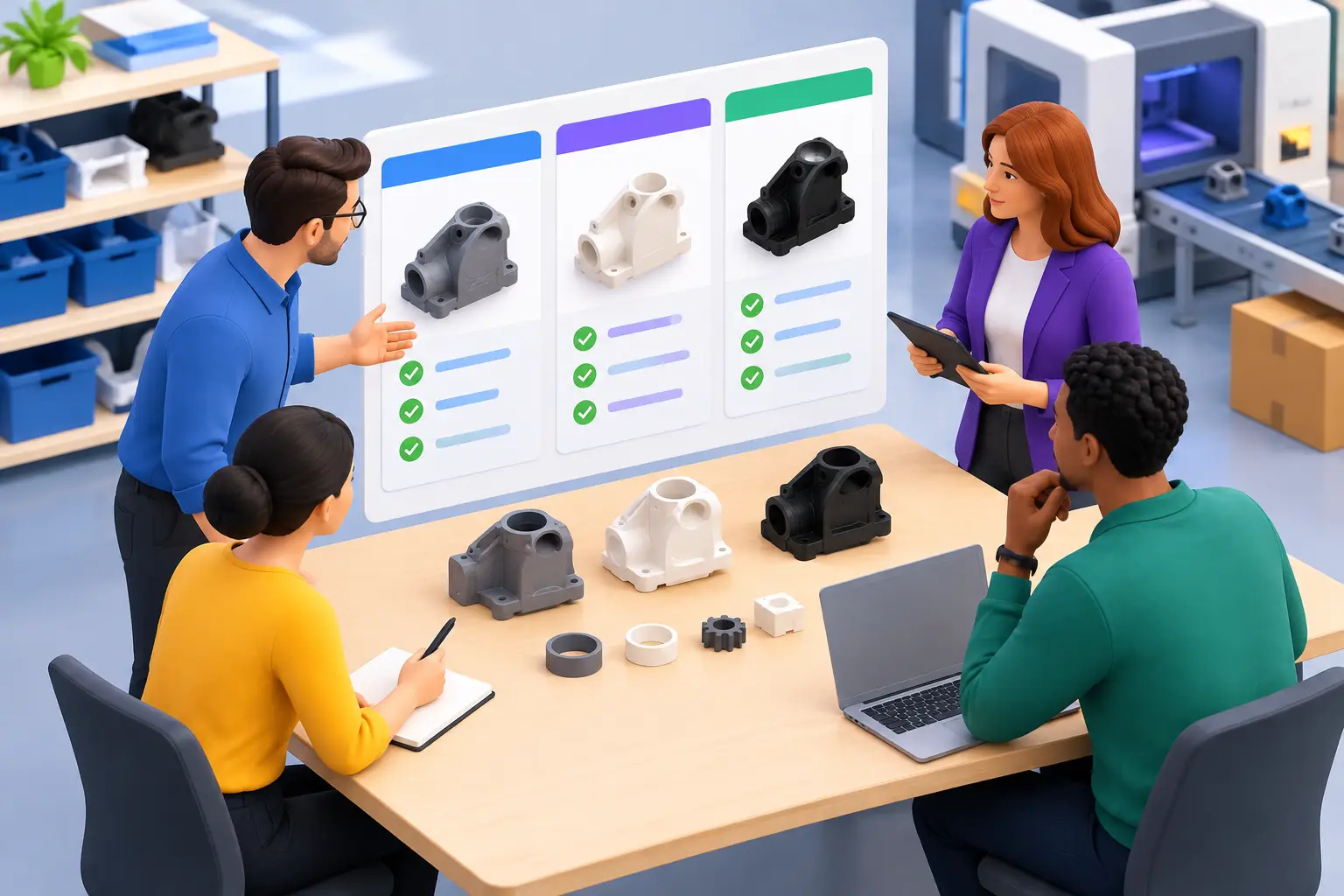
A prototype vendor review should begin before a CAD file is uploaded. A low unit price or fast stated turnaround can look attractive, but a prototype only helps the project when its material, accuracy, finish, documentation, and delivery timing match the decision you need to make. For engineering teams, product designers, and purchasing stakeholders, the review is a way to reduce avoidable iteration cycles.
The right vendor is not always the one with the widest list of technologies. It is the one that can turn a defined requirement into a traceable order with predictable production controls. That distinction matters when a prototype will be used for fit checks, functional testing, customer samples, internal approvals, or a bridge to low-volume production.
Start the Prototype Vendor Review With the Part's Purpose
A vendor cannot recommend a suitable process if the project brief says only that the part needs to be "strong" or "high quality." Define what the prototype must prove. A visual model may prioritize surface finish, colour, and fine detail. A functional enclosure may require impact resistance, heat tolerance, threaded inserts, or dimensional stability. A fixture may need repeatable fit across multiple components.
This step also clarifies whether the order is truly a prototype or an early production requirement. One-off concept models can accept more manual finishing and broader tolerances. Validation parts, pilot-run components, and customer-facing samples often need more controlled material selection, orientation planning, inspection, and packaging.
Provide the vendor with the intended use, critical dimensions, mating features, quantity, target date, and any known constraints. If a specific material grade, certification, or post-processing method is required, state it at the outset. Clear inputs make quotations more useful and prevent a vendor from pricing the easiest version of the job rather than the correct one.
Compare Material Options Beyond the Material Name
Material labels alone do not establish performance. Two parts described as nylon, resin, or thermoplastic can behave differently depending on the printing technology, build orientation, wall thickness, curing method, and finishing process. Ask how the selected process affects mechanical directionality, surface texture, porosity, temperature performance, and long-term stability.
For functional prototypes, request guidance tied to the application rather than a generic material chart. A component exposed to repeated flexing needs a different approach from a rigid cover with cosmetic requirements. Parts that contact moisture, chemicals, food-adjacent environments, or electrical equipment may also introduce requirements that must be assessed before production.
Colour selection deserves the same level of attention. A standard colour may be sufficient for an internal test, while a presentation model may need a defined finish or a colour combination that supports product review. Confirm whether colour is built into the material, applied after printing, or affected by a finishing stage. This can change both appearance and lead time.
Check for Design-for-Additive Feedback
A capable prototype vendor should identify risks before printing where possible. Thin walls, unsupported features, enclosed volumes, sharp internal corners, and tight assemblies can all create issues that are expensive to discover after delivery. The appropriate level of review depends on the order. A technically experienced team may need only a manufacturability flag, while a first-time buyer may benefit from more guidance.
The key question is not whether the vendor changes the design. It is whether the workflow makes exceptions visible and gives the customer a clear decision path. Design feedback should distinguish between a feature that cannot be produced, one that can be produced with a compromise, and one that simply affects cost or finish.
Evaluate Accuracy, Inspection, and Repeatability
Published tolerance ranges are useful, but they are not a complete quality plan. Ask how the vendor treats critical dimensions and whether inspection can be requested for features that affect fit or function. This is especially relevant for parts with mating surfaces, holes, snap fits, press fits, or interfaces with off-the-shelf hardware.
A reliable workflow records the order specification, selected technology, material, post-processing, and any agreed exceptions. For a single model, this helps resolve questions quickly. For repeat orders, it provides a reference point so the next batch is not treated as an entirely new request.
Repeatability also depends on change control. If a CAD revision is uploaded after quotation or production approval, the order process should make the revision visible. Teams need confidence that the part being printed is the part they approved, particularly when several people are involved in design, procurement, and testing.
Review Lead Time as a Production Schedule
Lead time should cover more than printer runtime. It may include file review, queue time, material preparation, printing, cooling or curing, support removal, finishing, inspection, packing, and shipping. A vendor that quotes only an optimistic print duration may leave the project team to absorb the rest of the schedule risk.
Ask what starts the production clock. Some orders move forward when payment is confirmed; others require final file approval, clarification of specifications, or receipt of a purchase order. These steps are normal, but they should be visible. For Canadian projects, shipping destination and delivery method can also affect the practical date when a prototype reaches the person who needs to test it.
Status tracking is particularly valuable when prototypes are connected to a review meeting, lab booking, customer demonstration, or supplier handoff. A clear order status reduces the need for manual follow-up and helps teams adjust their schedule early if a question or production issue arises.
Assess Pricing With the Whole Order in View
A useful quote makes cost drivers understandable. Part volume is only one factor. Technology, material, build orientation, quantity, support requirements, finishing, inspection, packaging, taxes, and shipping can all affect the final charge. An inexpensive raw print may become less suitable once the required finishing and delivery controls are added.
Compare quotes on an equivalent scope. If one vendor includes post-processing and another lists it as an optional charge, the prices are not directly comparable. The same applies to quality checks, rush handling, colour requirements, and shipping. Procurement teams should also confirm how invoices, payment records, and taxes are handled, particularly for project accounting and repeat purchasing.
Do not assume that the lowest cost is the best prototype decision. A more appropriate material or a better-defined finishing process may prevent a second order and preserve a testing deadline. Conversely, a high-spec process is unnecessary when the only goal is to verify overall form. The right spend depends on what the part must validate.
Test the Ordering Workflow Before You Need It
The ordering experience is part of vendor capability. A structured platform should allow customers to specify the relevant material, colour, technology, quantity, and post-processing choices without relying on scattered email threads. It should also preserve order details, provide account access, and show production and delivery status in one place.
For teams, look at how the process supports handoffs. Can a designer submit specifications while a purchasing stakeholder receives a clear invoice? Can the project owner check the latest order status without requesting an update from someone else? Can repeat jobs be located and reviewed without rebuilding the production brief?
Print3Dcanada is designed around this type of centralized order management, with configurable production inputs and trackable order activity. That structure is useful when prototype work involves more than a single file and a single buyer.
Questions to Resolve Before Placing the Order
Before approving a vendor, confirm four operational points: which file format and revision will be used, which material and finish have been selected, what quality or certification documentation is required, and what date represents delivery rather than production completion. These answers should be reflected in the order record, quotation, or written confirmation.
If the prototype is business-critical, add a contingency discussion. Ask what happens if the file requires clarification, a print fails quality checks, material availability changes, or delivery is delayed. No provider can remove every production risk, but a disciplined process makes responsibilities and next steps clear.
A strong prototype vendor review produces more than a supplier shortlist. It creates a production brief that can move from concept to order without losing the details that determine whether the part is useful when it arrives.