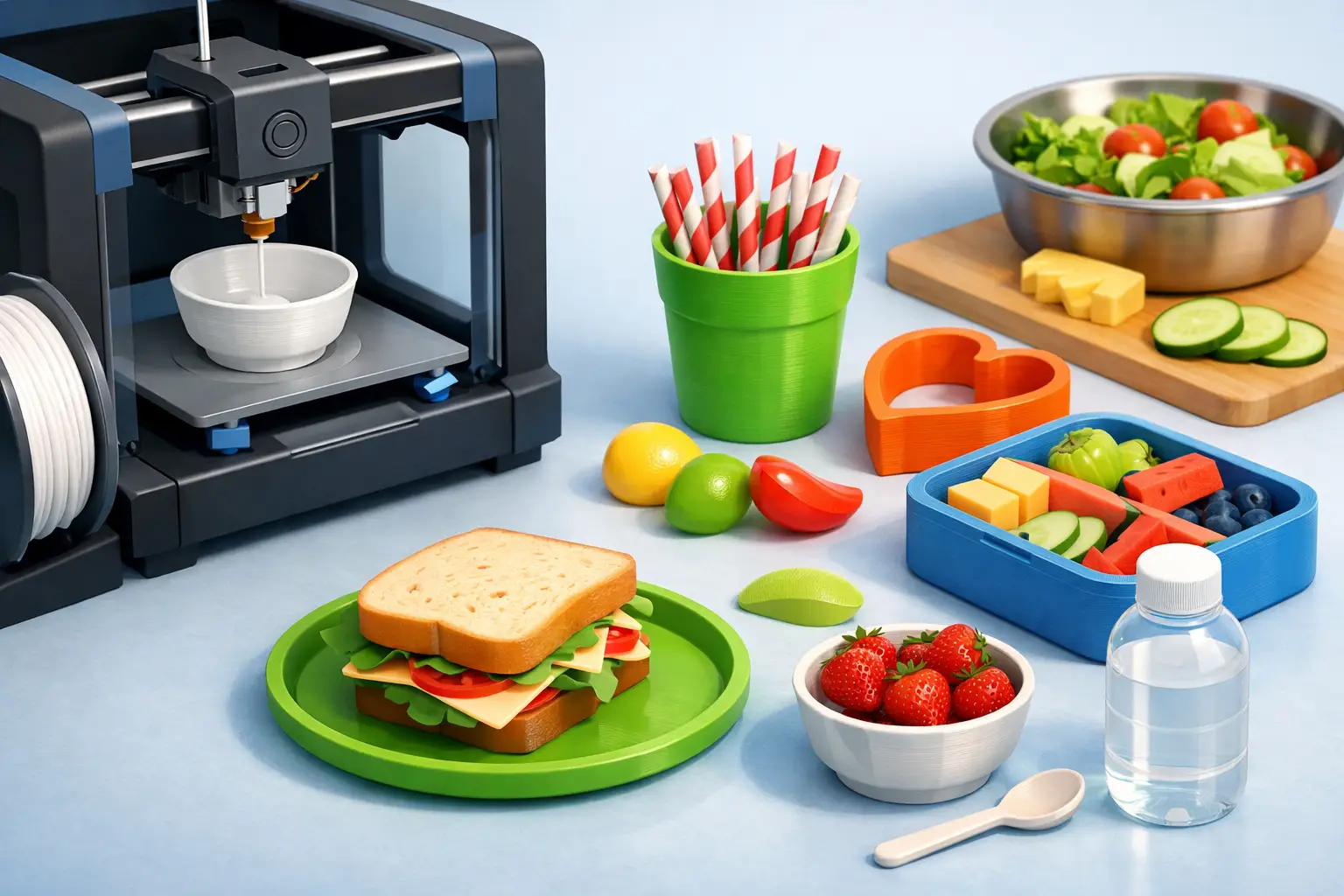
A cookie cutter, coffee dosing funnel, packaging fixture, or replacement mixer component may all contact food, but they do not carry the same material requirements. When customers ask what 3d printing materials are food safe, the useful answer is not a single filament name. Food-contact suitability depends on the material formulation, the printing process, the finished surface, cleaning conditions, and the intended use.
For production orders, food safe should be treated as a defined requirement rather than a general product label. Specify what the part will contact, for how long, at what temperature, and how it will be cleaned before selecting a material or requesting supporting documentation.
Food safe material versus food safe part
A material may be sold as food-contact compliant in its raw form, while the printed part is not automatically suitable for food use. Additive manufacturing changes the equation. Layer lines, internal voids, support marks, pigments, processing aids, and contamination from shared equipment can all affect the finished component.
This distinction matters most for parts used repeatedly or exposed to wet, fatty, acidic, or hot foods. A dry-food scoop used occasionally has a different risk profile from a dishwasher-cleaned valve, a reusable beverage fitting, or a production fixture that contacts meat or dairy.
In Canada, a supplier statement, data sheet, or test report may support a material decision, but it does not replace the responsibility to confirm that the finished part is appropriate for its intended food-contact application. Regulatory requirements can also vary by product category and use case. Where formal compliance is required, obtain documentation that applies to the specific material grade, colour, process, and intended conditions of use.
What 3D printing materials are food safe for practical use?
Several polymers and metals can be appropriate starting points. The correct option depends on temperature, food type, mechanical demand, cleaning method, and the level of documentation needed.
Polypropylene
Polypropylene, or PP, is widely used in conventional food packaging and food-service products. It has good chemical resistance and handles moisture well, making it a practical candidate for containers, caps, dispensing components, and low-to-moderate temperature fixtures.
For 3D printing, PP can be more difficult to print accurately because it tends to warp and has lower surface energy than many common filaments. That can affect bonding, finishing, and dimensional control. Use a documented PP grade and assess the printed surface before selecting it for repeated wet-food contact.
PETG
PETG is often considered for food-contact prototypes and functional parts because it is relatively easy to print, durable, and more moisture resistant than PLA. It can be a suitable option for dry-food tools, short-contact components, and lower-temperature applications when the specific filament or resin system has appropriate food-contact documentation.
Its limitation is heat. PETG can deform under elevated temperatures, particularly in dishwashers or near hot wash cycles. It is not the right default for parts exposed to boiling liquids, commercial sanitation, or continuous high heat.
PLA
PLA is common in desktop printing and may be available in food-contact suitable formulations. It is useful for simple, short-life applications such as dry-food guides, presentation models, or low-temperature tools. However, PLA softens at relatively low temperatures and can be difficult to sanitize reliably when printed with visible layer lines.
PLA is therefore better treated as a limited-use choice, not a universal food-safe answer. Avoid assuming that a natural-colour PLA part remains suitable after pigment changes, post-processing, dishwasher exposure, or repeated use.
Nylon and PA12
Nylon materials, including PA12, offer good toughness and are frequently used for functional components. Some grades are supported for food-contact applications, particularly in industrial powder-bed processes where material controls and traceability are available.
Nylon absorbs moisture, which affects both performance and cleaning considerations. Porous or unfinished nylon surfaces can retain moisture and residues. If the part will contact wet food or require frequent sanitation, surface finishing and validated cleaning compatibility should be part of the specification.
Stainless steel
For demanding, repeated food-contact use, stainless steel is often the most straightforward material category. It offers high heat resistance, strength, corrosion resistance, and a familiar path for cleanable food equipment. Printed stainless steel still requires finishing. An as-printed surface may be too rough for hygienic use, especially around seams, internal channels, and contact faces.
Machining, polishing, passivation, or other defined finishing steps can make a major difference. Stainless steel is generally more expensive and may have longer production lead times than polymer prints, but it is often the better decision for hot, wet, high-wear, or frequently cleaned applications.
High-performance polymers
Materials such as PEEK and certain PEI-based polymers can handle high temperatures and demanding chemical environments. They are used in specialized industrial applications, but they require capable equipment and careful process control. Availability, cost, and documentation requirements make them unsuitable for many simple parts, yet they can be justified when standard polymers cannot meet heat or performance requirements.
Materials that require extra caution
Photopolymer resins should not be assumed food safe. Standard SLA, DLP, and LCD resins can contain uncured compounds that are unsuitable for food contact. A resin described as low odour, tough, clear, or biocompatible is not necessarily approved for food contact. Only consider a resin when its manufacturer provides documentation for the exact product and intended conditions, and when post-curing requirements can be controlled.
Powder-based prints also need review. Selective laser sintering parts can have a textured surface that is difficult to clean without additional finishing. Material performance may be strong, but hygienic suitability depends on pore sealing, surface treatment, and the design of the part.
Colours and additives are another common gap. A base polymer may have supporting documentation, while a coloured version uses a different pigment package. Natural or uncoloured material is not automatically compliant either, but it can simplify the documentation trail. Confirm the exact material and colour combination rather than relying on a generic polymer family name.
The print process can change the result
A food-contact part should be produced on equipment with suitable controls. Shared nozzles, build plates, handling tools, and post-processing stations can introduce contaminants from previous jobs. For example, a brass nozzle may contain lead, and a printer previously used with filled, abrasive, or unknown materials may not be appropriate for a food-contact order without controlled cleaning and dedicated tooling.
Layer orientation also matters. Orienting a contact surface to reduce stair-stepping can make it easier to clean. Avoid deep grooves, inaccessible cavities, threaded areas that trap residue, and narrow channels that cannot be inspected or sanitized. If the component must be washed repeatedly, design for drainage and access rather than relying on a coating to solve an avoidable geometry issue.
Post-processing can improve the surface, but it must be selected carefully. Sanding may reduce roughness while creating areas that are harder to verify. Vapour smoothing, sealing, epoxy coatings, and paint systems can change cleanability, yet each introduces another material that must be suitable for the intended contact. A coating that is safe after full cure may still fail under heat, abrasion, or dishwasher detergents.
Define the use case before placing the order
A clear requirement prevents both over-specification and avoidable risk. Include the food type, maximum contact temperature, expected contact duration, frequency of use, cleaning method, required service life, and whether the part is for commercial production or personal use.
Also distinguish direct food contact from incidental contact. A fixture that holds sealed packaging may require different material controls than a component that touches exposed food. Likewise, a one-time prototype may not need the same surface finish or certification package as a repeat-use part installed in a food-processing workflow.
For organizations purchasing parts, retain the order record with material selection, colour, process, finishing requirements, and any available certificates or declarations. This creates a usable traceability record for quality teams, purchasing stakeholders, and future replacement orders. A structured platform such as Print3Dcanada helps keep these production inputs tied to the job rather than buried in email threads.
A practical selection approach
Start with the operating environment. For dry, cool, short-contact use, a documented PETG, PP, or PLA formulation may be workable depending on the required lifespan. For wet contact, repeated cleaning, or higher mechanical loads, documented PP or an appropriate nylon grade may be a better fit, provided surface finish is addressed. For hot food, aggressive cleaning, or long-term commercial use, finished stainless steel is often the more defensible choice.
Then verify the details that generic material names cannot answer: the exact grade, colour, manufacturing process, surface finish, cleaning compatibility, and supporting documentation. If any of those conditions are unknown, describe the part as a prototype or non-food-contact component until the requirement is resolved.
The most effective food-contact specification is usually brief but precise: state the material grade, intended food exposure, temperature limit, finish requirement, cleaning method, and documentation needed. That gives the production team a clear basis for selecting a process that fits the part, rather than treating food safety as a checkbox after printing.