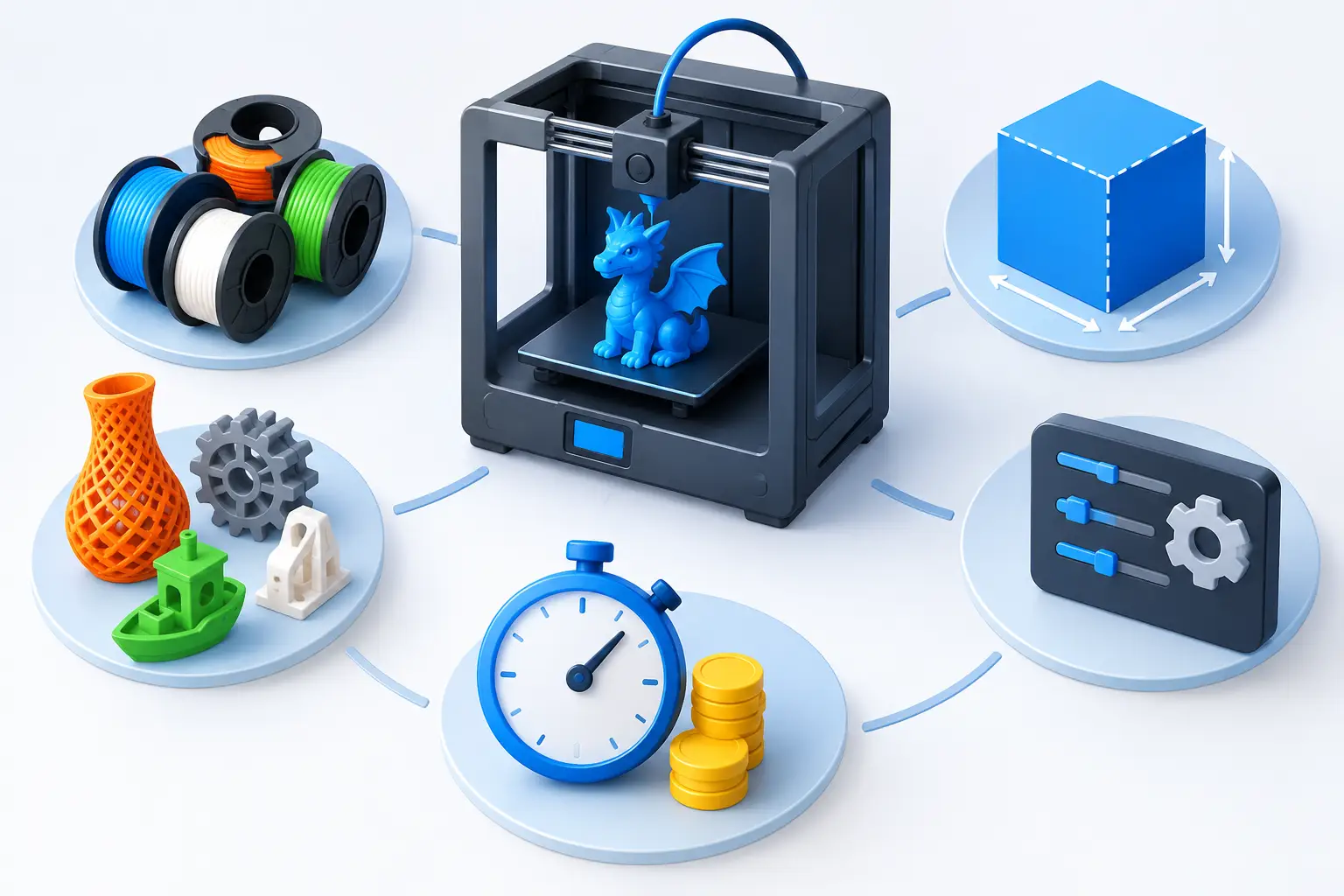
A small bracket and a large enclosure can use the same material, yet their quotes may be very different. The reason is that what affects custom print cost is not limited to the size of a part. A custom 3D print is a production job with inputs that include geometry, machine time, material use, setup, finishing, inspection, and fulfilment requirements.
For a useful comparison between quotes, define the required function first. A component intended for a fit check may need a different process, tolerance, finish, and delivery timeline than a part intended for repeated use. When specifications are clear at the order stage, the production route and associated charges are easier to predict.
What affects custom print cost most?
The largest cost drivers are usually print volume, build time, material and technology selection, and the amount of work required after the printer finishes. Their relative weight changes from one order to another. A tall, thin part can consume little material but require significant machine time. A compact part may print quickly but need extensive post-processing to achieve its required surface or dimensional result.
Part size, volume, and wall thickness
Material volume is a direct input to cost. Larger parts generally consume more resin, filament, powder, or other feedstock, and they occupy more capacity in a build. However, outside dimensions alone do not tell the full story. Internal cavities, infill strategy, wall thickness, and solid sections can substantially change material consumption.
Wall thickness also affects printability and durability. Very thin walls may require a finer process, a different orientation, or design changes to reduce the risk of distortion or breakage. Excessively thick sections can increase material use, extend cooling or curing time, and add unnecessary weight. Designing to the functional wall thickness is often more effective than simply making every area solid.
Geometry and build orientation
Complex geometry can add cost even when the part is small. Overhangs, enclosed channels, deep recesses, sharp transitions, fine text, and unsupported features may require supports, slower settings, or more manual handling. Parts that must be oriented in a specific direction for strength, surface finish, or dimensional control can also limit how efficiently a machine build is packed.
Support structures are a common example. They use material, lengthen preparation and removal work, and may leave contact marks that need finishing. Some printing technologies avoid conventional supports but introduce other considerations, such as powder removal from internal passages or build preparation requirements.
A design review before ordering can identify whether a minor change - such as adding a self-supporting angle, widening a channel, or splitting a part into two assemblies - reduces production effort without compromising function.
Material selection
Material choice affects both the raw material charge and the manufacturing process. Standard plastics may be appropriate for concept models, jigs, enclosures, and low-load components. Engineering-grade polymers, flexible materials, resins with specific performance properties, or metal options are selected for more demanding conditions and can carry different production and handling requirements.
The right material is based on the operating environment. Consider mechanical load, temperature exposure, moisture, chemical contact, electrical requirements, flexibility, appearance, and expected service life. Selecting a high-performance material for a simple visual prototype can raise the cost without adding useful value. Conversely, choosing a lower-cost material for a functional part may lead to failure, redesign, and a second production run.
Colour can also influence cost when it requires a specific material variant, dyeing step, coating, or controlled colour matching. If colour is not functional to the project, standard available options may provide a more efficient path.
Technology choice changes the cost model
Different additive manufacturing technologies calculate cost differently because they use different machines, feedstocks, layer resolutions, and post-print workflows. The lowest price is not always associated with the fastest-looking process or the lowest-cost material.
For example, a process suited to quick visual prototypes may not deliver the surface, strength, or tolerance needed for an assembly component. A process that produces a stronger functional part may have a longer build cycle or more post-processing. The most suitable choice depends on the required outcome, not on one specification in isolation.
Technology selection should account for these practical questions: Does the part need to carry load? Will it mate with another component? Is a cosmetic surface visible to users? Does it require fine features, internal channels, or a specific tolerance? Does it need repeatability across multiple orders? Each answer affects the production method and quote.
Post-processing and quality requirements
A part is not always ready to use when printing ends. Support removal, washing, curing, depowdering, sanding, polishing, coating, machining, threading, assembly, and painting can all add labour and handling time. These steps are often necessary, but they should be tied to a stated requirement.
Surface finish is a frequent source of quote variation. A standard print finish may be suitable for internal fixtures or early prototypes. Customer-facing components, presentation models, or parts with visible surfaces may require additional finishing. The cost difference reflects manual labour, additional materials, inspection, and the need to protect the part through each stage.
Tolerances matter in the same way. Tight dimensional requirements can require process controls, orientation planning, calibration, measurement, or secondary machining. A general tolerance is appropriate for many applications, while a critical mating feature may need a more controlled specification. Identify critical dimensions on the design rather than applying an unnecessarily strict requirement to every surface.
Certification, traceability, and documented quality checks may also affect pricing. For professional procurement, these records can be essential. They introduce administrative and inspection work that should be planned into the order rather than requested after production has started.
Quantity and production planning
Ordering more units does not always multiply the price by the same amount. Setup, file review, machine preparation, and certain finishing tasks can be distributed across a larger quantity. Parts can also sometimes be arranged more efficiently within a build. This is why a batch of ten may have a lower per-unit cost than ten separate orders.
That said, volume savings depend on part geometry, available machine capacity, material availability, and the required lead time. A large part may occupy most of a build regardless of quantity. A highly finished part can retain a significant per-unit labour cost even in larger batches.
Repeat orders benefit from consistent files and specifications. Keep the approved version, material, colour, finish, and revision notes associated with the job. For teams, centralized order records reduce the risk of quoting or producing an outdated revision.
Delivery timing, shipping, and order administration
Standard production scheduling provides the best opportunity to align a job with available machine capacity. Expedited work can require priority planning, changes to the normal queue, or separate shipment arrangements. If a deadline is fixed, provide it with the order so production and delivery can be assessed together.
Shipping cost depends on package dimensions, weight, destination, insurance requirements, and delivery service. A lightweight but oversized model may cost more to ship than a dense, compact component. For Canadian projects, delivery planning is especially useful when parts must reach a remote site, a project location, or multiple team members.
Commercial requirements also form part of the job. Purchase-order references, invoices, payment processing, account access, and shipment tracking may not change the printed part itself, but they support a controlled purchasing workflow. Print3Dcanada provides a structured way to keep these production and order details connected.
How to control custom print costs before ordering
The most reliable cost control starts in the design file. Remove material that does not serve a functional purpose, avoid unsupported features where possible, and specify only the tolerances and finish levels the application requires. If the part is an early prototype, state that clearly so the production method can match the stage of development.
It also helps to separate non-negotiable requirements from preferences. Strength, fit, heat resistance, or a certified material may be essential. A premium finish, exact colour, or urgent turnaround may be optional. This distinction makes it easier to evaluate alternatives without compromising the project.
Before submitting a job, confirm the file revision, unit quantity, material, colour, post-processing, critical dimensions, and delivery need. A complete specification reduces clarification cycles and makes the quote more representative of the finished part.
Custom printing works best when cost is treated as a result of production choices, not a number attached only to a file. Define what the part must do, then select the simplest production route that reliably delivers that result.